

I stopped making New Year’s resolutions years ago because I tend to forget them the next day or never make it through the first quarter. Plus, the formality and expectations create predestined failure for someone like me (with ADHD).
Research shows 80 – 90% of New Year’s resolutions fail by February or March – so it’s not just me.
Towards the end of December 2025, I started feeling antsy. I perform best when a clear system anchors me – otherwise I feel like I’m wandering in the dark, relying on the dim brightness of my phone screen to guide me. The system I used in 2025 left me scattered, so I desperately needed something new.
While body-doubling with a friend to plan 2026, I realised my planning lacked a unifying intention and purpose. It felt scattered and random – which explained why I felt scattered.
Setting intention and purpose anchors you deeper. It clarifies why you do what you want or have to do, helps you make better decisions and strengthens personal agency. Your calendar is not running you, you are running it.
This becomes what you rely on, when procrastination kicks in and external motivators fail.

Why ADHD Brains Struggle with Motivation (The Neuroscience)
Motivation. It feels wonderful when we feel motivated, but how do we sustain this when internal motivation disappears? Or when starting feels impossibly hard?
The Dopamine Problem in ADHD
According to the Dynamic Developmental Theory of ADHD (Sagvolden et al., 2005), the core issue centres on a dysfunctional dopamine reward system. Dopamine doesn’t create pleasure – it drives anticipation, reward prediction, and reinforcement learning.
When you do something rewarding, dopamine helps your brain remember: “This action led to something good. Do it again.”
ADHD brains experience alterations in dopamine neurotransmission affecting release, reuptake, and receptor sensitivity.
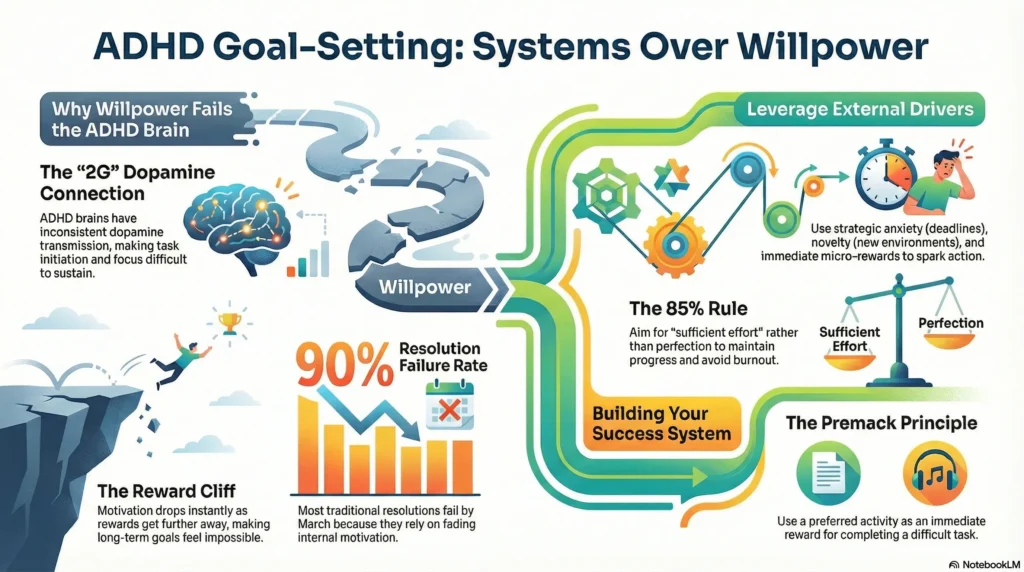
ADHD brains don’t get 5G connection like everyone else – we get 2G. If we’re lucky, 5G kicks in, but it lags and inconsistently delivers.
How Delayed Rewards Fail ADHD Brains

ADHD brains have what researchers call a steeper and shorter delay-of-reinforcement gradient. The further away a reward sits, motivation feels dramatically diminished.
For neurotypical brains, the motivation curve slopes gently. For ADHD brains, it drops like a cliff.
This explains why you can hyperfocus on video games (immediate feedback) but can’t start work projects (reward arrives weeks away), why deadlines create sudden motivation, and why long-term goals feel impossible.
Dopamine provides the required ingredient for planning, impulse control, working memory, and task initiation. When dopamine signalling fails, these functions struggle.
Telling someone with ADHD to “just focus” is like telling someone with poor eyesight to “just see better.”
Now, let’s remove the shame around “lack of willpower.” This shame consumes mental and emotional energy and keeps us stuck (on that couch).
The Three External Motivators That Actually Work for ADHD

When internal motivation fails, we need external means.
External motivators rely on three key drivers:
Strategic Anxiety – Time sensitivity, urgency, accountability
Novelty – Something new, interesting, engaging
Reward – The prize at the end
Using Anxiety Strategically
Anxiety floods your system with adrenaline and cortisol, creating urgency and sharpening focus, creating “miraculous productivity”.
This explains why deadlines make the impossible possible – the immediate consequence overcomes executive function challenges. Think of the overdue presentation or the house that gets clean when guests visit.
Use anxiety strategically for short-term, lower-stakes tasks with firm deadlines. The key is recognising when it stops helping.
Anxiety becomes harmful when it reduces capacity, instead of supporting action.
Watch for these signs:
- You delay, freeze, avoid, or over-prepare without actually progressing
- Stress bleeds beyond the original task – into sleep, relationships, appetite, or concentration
- You lose flexibility, curiosity, and perspective; everything feels urgent, all-or-nothing, or catastrophic
- After the task ends, tension lingers and your body doesn’t settle
Ask yourself after anxiety-driven productivity: “Do I feel more resourced or more depleted?”
Depletion means anxiety has crossed from tool to burden.
The problem appears when anxiety-driven productivity becomes your default. Running your nervous system in constant crisis mode leads to exhaustion and burnout. The crash hits hard – physical fatigue, emotional depletion, and shame.
For ADHDers, this pattern reinforces the “lazy” narrative when really your dopamine system just requires more intense stimulation.
If you constantly manufacture crises, you need better systems, not more anxiety.
Harnessing Novelty Without the Trap
Our brains crave novelty because new experiences trigger dopamine release. For ADHDers, your brain searches for stimulation to compensate for that weak dopamine signal.
This explains why productivity apps feel amazing for two weeks, why starting projects exhilarates but maintaining them tortures, and why you research the “perfect system” but can’t implement one for more than a month.
The trap lies in expecting novelty to sustain long-term behaviour.
Short-term systems that embrace novelty work brilliantly: gamifying tasks or switching exercise routines.
The key is knowing when novelty has an expiration date and start planning for it.
For long-term goals, either build in rotating novelty or anchor the behaviour to something more stable – like intention and purpose.
Accept that your system needs refreshing every 3-6 months. Design systems that expect your need for stimulation. Rotate through three planning methods. Change your workspace regularly.
Structuring Immediate Rewards

Rewards come in two forms: intrinsic (internal satisfaction, pride) and extrinsic (tangible prizes, praise).
For neurotypical brains, intrinsic rewards suffice. ADHD brains struggle with delayed gratification. When the reward sits far away or remains vague, the dopamine signal barely registers.
Structure immediate micro-rewards instead of waiting for distant payoffs.
Break tasks into tiny chunks and reward yourself: answer three emails, then stretch; write for 10 minutes, then scroll for three.
This is where I discovered my “What would I rather be doing?” strategy was working pretty well – that preferred activity becomes your micro-reward.
Make rewards immediate, consistent, and genuinely rewarding to you.
Finding Your Why (Intention + Purpose)
Add something internal to external drivers: intention or purpose. Choose something within your locus of control.
To find your “why“, work through three layers:
- State your surface goal (what you want)
- Identify the immediate impact (what changes)
- Ask “why does that matter to me?” (personal value)
Example: “I want to exercise (what) so that I have more energy (impact) because I value being present with my family (core value).”
Your why must be within your control – it can’t depend on others’ approval or external validation.
“Because I want to feel capable” works; “because my partner will feel proud” doesn’t.
Connect your why to what you actually value (health, peace, autonomy, growth, connection).
Write it down, make it visible, and pair it with external motivators when dopamine needs a boost.
"What Would I Rather Be Doing?"
Sometimes thinking about what reward to match each task feels too hard – that alone creates another daunting, long to-do list.
The Premack Principle states that preferred behaviours can reinforce less preferred ones. Use something you want to do as a reward, for something you don’t. This follows “Grandma’s Rule” – “First eat your vegetables, then have dessert.”
This strategy works powerfully for ADHDers, because we often already know what we would rather be doing. You leverage desire for the valued activity to fuel the boring task, creating immediate motivation.
Instead of distant rewards (“I’ll feel accomplished eventually”), you create instant reinforcement: 15 minutes of exercise, then 15 minutes of reading.
Your brain gets the dopamine hit from the preferred activity, which reinforces personal accomplishment for completing the avoided task, making you more likely to repeat the pattern. Double win (intrinsic + extrinsic rewards)!
My ADHD Goal-Setting Strategy for 2026
I’ve simplified my goals whilst keeping them interesting – the right amount of challenge. Not so easy I lose interest, not so hard I shy away.
I’m planning in 3-6 month chunks instead of a full year. This makes goals attainable, manageable, and less overwhelming – using the 85% rule.
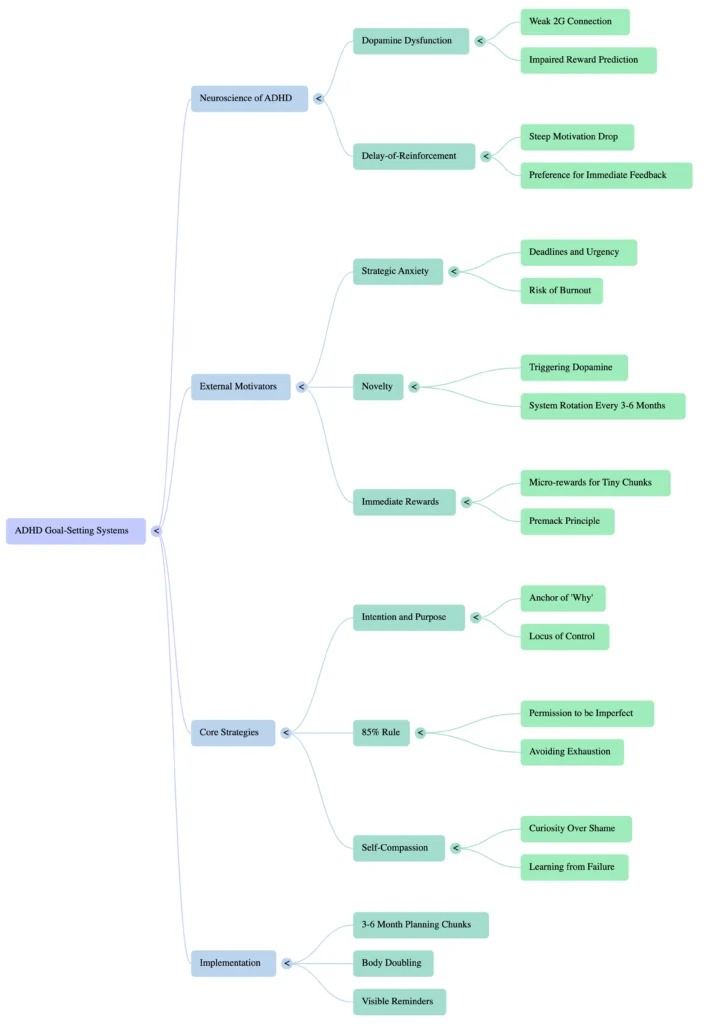
You can download my infographic and visual framework for easy reference and create your own framework that fits your needs and goals.
The 85% Rule: Permission to Be Imperfect
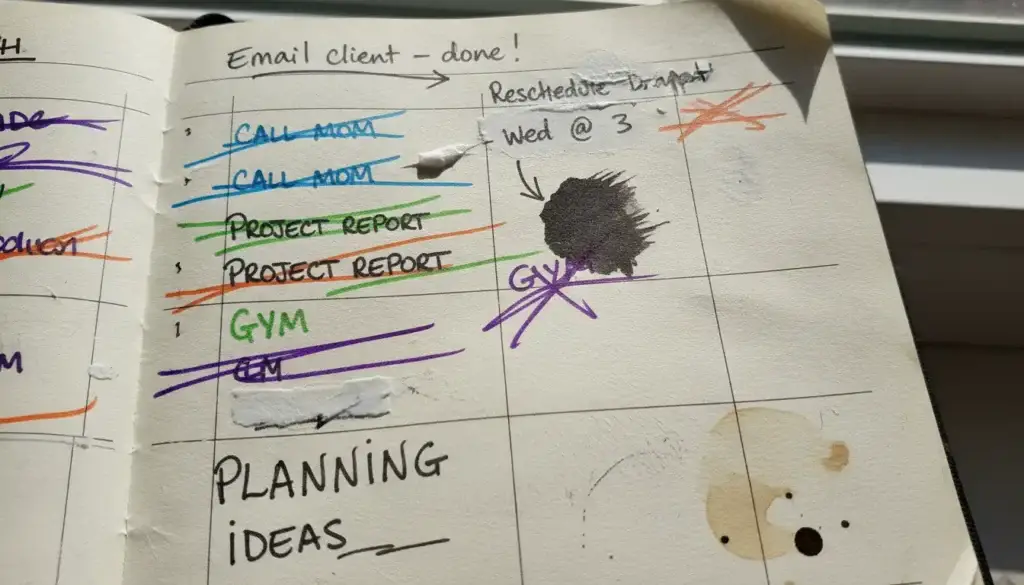
I’m not aiming for 100% or perfection. I’m trying the 85% rule – sufficient effort that doesn’t lead to burnout.
The 85% Rule originated from studying sprinter Carl Lewis, who ran faster at 85% effort than maximum capacity.
When you aim for 85% instead of 100%, you perform better because staying slightly below your limit allows you to relax, maintain form, and avoid counterproductive tension.
For those with ADHD or perfectionism, the 85% Rule gives explicit permission to be imperfect whilst making meaningful progress.
You shift focus from binary outcomes (finished vs not finished) to acknowledging invested time and effort.
With 85%, you maintain long-term progress without the exhaustion and shame cycle from unrealistic 100% standards.
Relief from perfectionism, creates space for surprising results.

Honestly, I don’t know if I’ll sustain this new system. So I’m telling myself it’s okay if it doesn’t work – I learnt something.
After being briefly hard on myself if I don’t meet targets, I’ll be kind. And then get curious and ask, “Why didn’t it work?”
With curiosity, I learn what worked and what didn’t. I gain insight and (better) ideas for doing things differently.
When there is self-judgement and shame, it paralyses progress, reinforces deeper shame, and perpetuates anxiety.
I have to stop editing this post. 85% remember? I do want to write another blog post in 2 months (fingers-crossed)!
I wish you a year of inner peace and personal fulfilment.
I’d love to hear from you: What’s one system or strategy you’re trying this year? What does your 85% look like?
Leave a comment below – your insights might inspire others.
Recommended Resource
Many of these ideas came from a video by Dan Pink on YouTube.
I found the “pre-mortem” concept particularly thought-provoking – “What would you regret not doing this year?”
You can download my infographic and visual framework for easy reference and create your own framework that fits your needs and goals.
Frequently Asked Questions
Many goals rely on consistency, delayed rewards, and sustained self-discipline. For many people with ADHD, these conditions are not supportive for long.
When motivation fades, the goal often falls away.
This is not a personal shortcoming, it is a mismatch between how goals are designed and how some nervous systems work.
It means shifting the focus from trying harder to understanding what helps you move.
A system is the set of supports, structures, and conditions that make action more likely for you, especially on low-energy or low-motivation days.
Resolutions tend to focus on outcomes and rely heavily on motivation.
Systems focus on process and support. They can pause, adapt, or change shape when life shifts, rather than breaking when things get messy.
Falling off track is expected. The more useful question is how easy it is to return.
A supportive system assumes interruption and makes re-entry possible, without turning it into a moral failure.
There is no single approach that works for everyone.
ADHD shows up differently across people and across seasons of life.
The aim is not to find the right answer, but to notice what helps and adjust from there.
Some people prefer to experiment on their own.
Others find it helpful to work with a therapist or coach who understands ADHD and focuses on systems rather than discipline.
Support can reduce self-blame and make the process gentler.
Need a space where you’re understood?
You’re always welcome at Therapeutic Space, where we talk honestly about neurodivergence, identity, and self-discovery, without shame and without masks.
References
Sagvolden, T., Johansen, E. B., Aase, H., & Russell, V. A. (2005). A dynamic developmental theory of attention-deficit/hyperactivity disorder (ADHD) predominantly hyperactive/impulsive and combined subtypes. Behavioral and Brain Sciences, 28(3), 397-468.
Sagvolden, T., Aase, H., Zeiner, P., & Berger, D. (1998). Altered reinforcement mechanisms in attention-deficit/hyperactivity disorder. Behavioral and Brain Research, 94(1), 61-71.