

The Q1 Reality Check
It’s March (already)?
The first quarter of every year seems to whoosh by for me. Just getting that break to look up, catch a breath, and it’s March – and I’ve only managed to achieve a third of what I had ambitiously set out to do. If you’re neurodivergent, goal setting can feel like a particular kind of trap: ambitious in January, quietly abandoned by March.
I overestimated my ability to achieve certain goals. But I wouldn’t say I failed. I did get stuff done – just not within the timeframe I thought I could. Life happens. There were things I hadn’t anticipated: new demands, distractions, and honestly, lost momentum and motivation. There. I’ve said it. Coming from a therapist who helps other people with motivation.
Being unmotivated is a reality – neurodivergent or not. It’s a part of our experience that we often beat ourselves up about. It’s laden with guilt and shame, and comparison. How does that other therapist manage to churn out video content consistently, when I have post-production experience and can’t get one post done?
If any of that resonates, keep reading. Because the problem probably isn’t your discipline. You may be trying to navigate a neurodivergent life using a neurotypical map.
Ability is Context-Dependent, Not Fixed

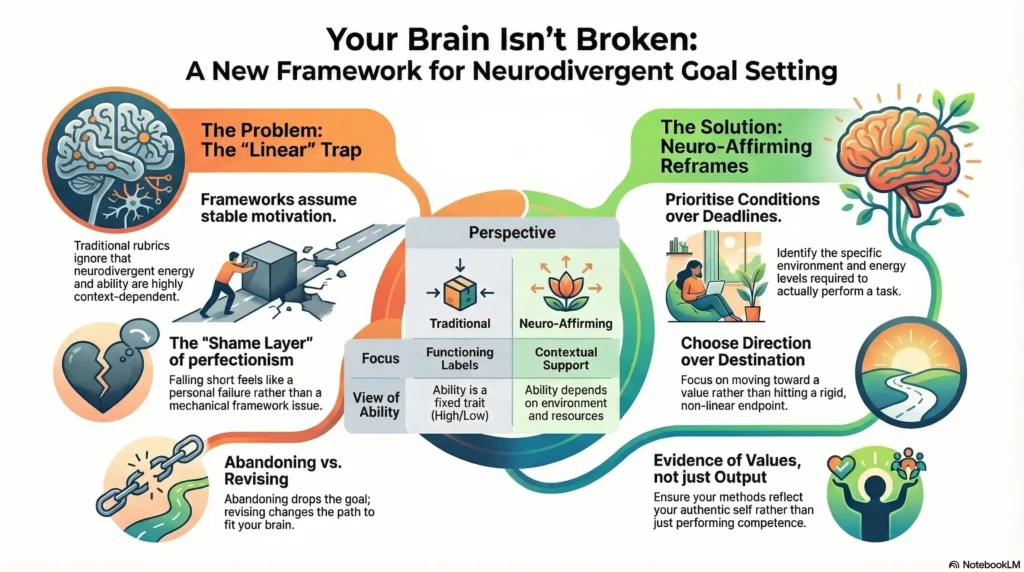
Quarterly goals. SMART frameworks. Productivity metrics. These structures were designed for consistent, linear output. They assume stable motivation, predictable energy, and that effort applied consistently produces proportional results.
For many neurodivergent brains, none of those assumptions hold.
We often hear language like “high-functioning” or “low-severity” in clinical and everyday contexts. Such language is deficit-focused and tends to treat ability as fixed. But we know from lived experience that ability is context-dependent. You may be highly effective at work and genuinely depleted at home by 7pm. That’s not inconsistency. That’s how the brain works.
Bottema-Beutel et al. (2021) proposed a more useful framing: instead of functioning labels, describe support needs in context. For example, a person “requires substantial support to participate in unstructured recreation activities, but minimal support to complete academic work.” This acknowledges both the strengths and the genuine variability – without pathologising either.
So the question is worth asking directly: Was your ability ever the problem, or was it always the context?
The Shame Layer

Earlier this year, I set a goal to create video content for my practice. I tried it, I hated it, and I stopped. Immediately, my internal critic screamed: “You’re a hypocrite. You’re telling others to just start while you’re quitting.”
I felt stupid, guilty, pretentious. I told myself off for having too many excuses: not the right equipment, time, mood, energy level. I rolled my eyes at myself.
The self-criticism ran deep, and it was specific. My expectations were at television commercial level, while I was struggling to string together a short social media post. The gap between what I expected of myself and what I was actually producing felt unbearable, not just frustrating.
And here’s the thing: therapists are not exempt from this. We can hold the clinical knowledge and still feel it fully.
When Falling Short Feels Like Proof
That gap is worth naming. Researchers call it procrastinating perfectionism, and for many neurodivergent people it doesn’t feel like ordinary disappointment.
The internal critic doesn’t say “you fell short.” It says “this confirms what you always suspected about yourself.”
In other words, it isn’t just about the video. It’s about everything the video represents: competence, credibility, proof that you are capable despite a long history of being underestimated or dismissed. The stakes suddenly become so high.
This is also where perfectionism gets complicated for neurodivergent people. It isn’t simply high standards.
Rather, it often functions as a correction mechanism: a way of compensating for and overwriting a history of shame (Flett & Hewitt, 2014). The thinking goes: “If I can just perform at a high enough level, consistently enough, perhaps that corrects the record.”
As a result, the perfectionism and the difficulty with motivation aren’t opposites. They’re the same wound operating in two directions at once:
- Perfectionism: The frantic drive to over-perform to escape shame.
- Difficulty with Motivation: The paralysis and procrastination caused by an intense fear that anything less than perfection will confirm our deepest fears about our incompetence.

Research supports this pattern. Yosopov et al. (2024) found that procrastinating perfectionists show a cognitive hypersensitivity to failure, with a tendency to overgeneralise failures to the self rather than to the task.
Hmm. Sounds familiar, doesn’t it?
Revising Versus Abandoning

This distinction matters, because self-compassion without structure can easily become permission to drift (Sirois, 2014).
- Abandoning: Deciding a goal no longer matters simply because the process felt bad or triggered shame.
- Revising: Keeping the core value intact while changing the path, timeline, or method to fit your actual brain.
One question worth sitting with: does this goal still reflect something I actually care about, or am I holding on to it because I think I should care about it?
Neurodivergent Goal Setting: Designing for Your Brain

The context-dependent framing applies practically here.
Just because you are highly organised in one area doesn’t mean the same capacity transfers elsewhere. Being on top of client scheduling doesn’t mean I’ll be equally effective at organising my wardrobe. These draw on different cognitive resources, in different environments, at different energy costs.
Three reframes that tend to work better for neurodivergent people:
Conditions rather than deadlines.
Instead of “I will do X by Y date,” ask:
- Under what conditions can I actually do X?
- What environment, energy level, or support does this require?
A goal set during a high-focus period may be completely unrealistic for the depleted version of you three weeks later. That’s not weakness. That’s variable capacity, and planning needs to account for it.
Direction rather than destination.
For interest-based nervous systems, rigid endpoints can kill momentum before you start.
Direction over destination. Not every step looks like progress from the outside, but movement doesn’t have to be linear to be real.
Evidence of values, not just output.
What does pursuing this goal say about what matters to you?
If the method isn’t reflecting your values – as the video wasn’t reflecting mine – the goal needs rerouting, not abandoning. The value (authentic communication) was sound. The vehicle wasn’t.
The Bigger Reframe
The point of all this isn’t to lower the bar.
It’s to stop applying a framework that was never built for your brain, and then concluding the brain is the problem.
We’ve been conditioned by our environments, and it’s not easy to shift this. Given the pathologising language that has historically described neurodivergence, there is also an internal pressure to prove others wrong – to perform competence according to a standard that was never designed with your brain in mind.
Here’s what I want to leave you with for now: the same cognitive traits that make linear goal-setting genuinely harder – the non-linear thinking, the variable motivation, the tendency to go deep rather than broad – are not simply liabilities.
That’s a different argument, and it’s worth making properly.
Part 2 will take that argument further.
Questions for Reflection
- Whose rubric have you been using to measure your progress?
- Is the goal something you still value, or something you think you should value?
- What conditions would make this goal actually achievable for your brain?
References
Bottema-Beutel, K., Kapp, S. K., Lester, J. N., Sasson, N. J., & Hand, B. N. (2021). Avoiding ableist language: Suggestions for autism researchers. Autism in Adulthood, 3(1). https://doi.org/10.1089/aut.2020.0014
Flett, G. L., & Hewitt, P. L. (2014). The perceived contrast of perfectionism and forgiveness. Journal of Rational-Emotive & Cognitive-Behavior Therapy, 32(1), 1–18.
Sirois, F. M. (2014). Procrastination and stress: Exploring the role of self-compassion. Self and Identity, 13(2), 128–145.
Yosopov, L., Saklofske, D. H., Smith, M. M., Flett, G. L., & Hewitt, P. L. (2024). Failure sensitivity in perfectionism and procrastination: Fear of failure and overgeneralisation of failure as mediators of traits and cognitions.