
This post draws on peer-reviewed research and the World Economic Forum’s Future of Jobs Report 2025. Research findings describe patterns across groups-they don’t apply to every individual. I also write from my own experience, not just the literature.
A conversation runs through neurodivergent advocacy – in academic circles, in online communities, in therapy rooms. It goes something like this: the playing field is uneven. Neurodivergent (ND) brains are hunters and gatherers in a farming world.
The DSM-5-TR diagnostic criteria for Neurodevelopmental Disorders (e.g. ADHD, Autism, learning differences, etc.) describe behavioural deficits in an industrial-age classroom or a linear-progression workplace. And it’s 2026 – that world is changing faster than most of us expected.
The challenges don’t disappear. But context matters more than we give it credit for. And the context is shifting – and that’s exciting.
The Industrial Age Built a Particular Kind of "Smart"

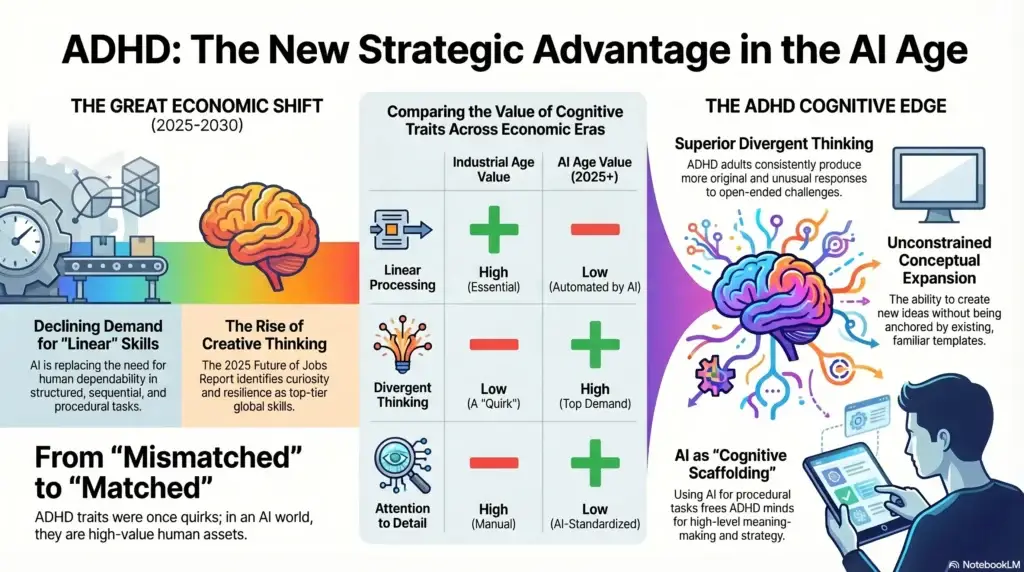
Traditional school and workplace systems ran on linear progression. They rewarded sitting still, following instructions in sequence, producing consistent output, and demonstrating competence through memorisation and repetition. Reliability. Predictability. All incredibly efficient and productive. But anything else – creativity, divergent thinking, restlessness – was a quirk. Cute. Nice to have, but not valued.
The industrial age didn’t build itself for minds that resist going step by step.
Researchers have pointed out that ADHD diagnostic criteria describe deficit behaviours specifically in that kind of environment. Difficulty sustaining attention (on tasks that aren’t interesting – though attention itself is far more complex than a single on/off switch). Difficulty following through (on systems designed for other brains). Impulsivity (in settings that demand long queues of waiting). The “disorder” was partly a mismatch all along.
Researchers have debated whether ADHD is a disorder at all. Some argue that understanding ADHD requires consideration not only of its biology, but of social and psychological contexts – that the diagnosis itself takes shape in the environments where certain behaviours become problems (Cooper, 2008; Freedman & Honkasilta, 2017; Honkasilta & Koutsoklenis, 2022).
I find this convincing. Context matters – and the context is changing.
What the World Economic Forum Found in 2025
Every two years, the World Economic Forum surveys over a thousand major employers across 55 economies. Their 2025 Future of Jobs Report names the skills that will matter most through 2030.
At the top: creative thinking, curiosity and lifelong learning, resilience and flexibility, systems thinking. Skills like dependability and attention to detail – the bread and butter of the industrial-age workplace – sit on a downward trend in employer demand.
Not because those skills become worthless. Because AI now handles the structured, sequential, procedural tasks. What remains – what AI still can’t replicate – is the capacity to think laterally, make unexpected connections, hold ambiguity without freezing, and generate ideas nobody has had before.
That’s a different game. And many ND minds have spent their whole lives quietly training for it – without anyone telling them it counted.
What the Research Shows About ADHD and Creativity
Research consistently finds that adults with ADHD outperform their non-ADHD peers on divergent thinking – the ability to generate multiple, varied, and original responses to an open question. Not just more ideas, but more unusual ones. More original ones.
White and Shah (2006, 2011) found that ADHD adults reported higher real-world creative achievement across visual arts, music, invention, theatre, and science.
Researchers also study something called conceptual expansion – the ability to step outside an existing template when creating something new.
In one study, participants invented fruit that might exist on another planet. ADHD adults created fruit that looked significantly less like Earth fruit. Their thinking broke further from the familiar. Less anchored by “but this is how fruit works.” That sounds like a quirky lab finding – in a world that needs people to think beyond existing templates, it matters.
Boot, Nevicka and Baas (2020) added an important nuance: ADHD adults didn’t consistently outperform controls on creativity tasks unless something changed the stakes – competition, a meaningful reward, genuine pressure. Add that, and they generated significantly more original ideas.
(Sounds familiar? Yeah.)
This is the interest-activation piece most ND people know intimately. The capacity is there. The on-switch is just wired differently.
A former boss in film and TV once told me: “if you can imagine it, you can create it.” At the time I took it as professional encouragement. Now I read the research, and it totally makes sense
The goal isn’t to be generically creative on demand — it’s to know what switches you on, and build work structures that honour that.
When "Useless" Skills Turn Out to Matter

I’ve written elsewhere about my late ADHD diagnosis. Part of that story involves decades of developing what I privately called useless skills – creative, hands-on things I pursued because my hands needed to make something. Always. I couldn’t explain the compulsion.
For three years, I volunteered at my daughter’s school – my own alma mater – and co-created the Maker Recess programme, a space for kids to explore making and develop ideas. The official goal: give kids room to be curious. My unofficial ambition: teach them to think like ADHDers. Divergently. With no wrong answers. With failure as information, not verdict. The programme has since attracted substantial donor funding and continues to grow.
Here’s the strange part. In that parent volunteer group, people said kind things – you’re so creative, you’re so good at making things. And I’d think: forty years ago the teachers in this same school told me to stop wasting my time on exactly this. These things aren’t useful.
Now schools fund them.
Context determines what counts as a strength. That’s the whole point.
The Honest Version
This isn’t a “congratulations, ADHD is actually a superpower” post. That framing minimises the real struggle.
The same research that shows ADHD advantages in divergent thinking also shows consistent disadvantage in convergent thinking – the kind that requires holding a single line of reasoning, suppressing distractions, arriving at the one correct answer.
That gap between having an idea and finishing it, refining it, implementing it – that’s very real too, and it is the likely cause of “failure,” the loss of stamina to see things through.
The argument here is more specific: the environment is shifting in ways that change the relative value of different cognitive styles.
AI substitutes best for the same tasks ND minds find most effortful – structured processing, sequential execution, consistent output. The tasks that remain distinctively human and distinctively valuable are increasingly the ones ND minds move toward naturally.
That’s not a reason to stop working on hard things. It’s a reason to stop treating your wiring as a defect that needs correcting before your actual life can begin.
AI, Cognitive Load, and What I've Noticed in My Own Brain

One thing ND circles don’t discuss enough is variability.
Not just the highs – the hyperfocus, the bursts of output – but the lows. Days when a task that should take twenty minutes takes two hours, not because the thinking is harder but because the activation isn’t there. Getting started. Keeping the thread. Translating the idea into sentences. Each step costs more than it should.
I’m also part of a generation that didn’t grow up with technology the way it is integrated today. Before these tools existed, I invented my own systems – workarounds, compensatory strategies, ways of working that nobody designed for brains like mine.
Some of that was unnecessarily hard. But it built something: a different perspective and approach to problem-solving, and sometimes coming up with creative solutions to tedious tasks.
I use AI tools in my own work – including in developing this piece. AI reduces that cognitive load for me. Not the thinking – the thinking stays mine – but the scaffolding. The first structural draft. The procedural parts. That lighter load frees more of my capacity for the work I’m actually here to do: the conceptual thinking, the questions, the meaning-making.
I’m more productive. And I feel more like myself, not less.
Where Does This Leave Us?
Neurodivergent advocacy has always made a contextual argument: the brain isn’t the problem. The environment is.
What’s new in 2026 is that the environment is visibly, structurally shifting – not because society grew more compassionate (though awareness has grown), but because the global economy is restructuring around a different set of cognitive demands. The minds that were mismatched for one era may find themselves considerably better matched for this one.
For a long time, I’ve been drawn to a story by the Argentine writer Jorge Luis Borges, The Garden of Forking Paths, where he described time as “a growing, dizzying net of divergent, convergent and parallel times” – a network that approached, forked, broke off, and embraced all possibilities.
I think about that image when I think about what it means to have a brain that doesn’t run on a single track. Branching. Forking. Holding multiple possibilities open at once.
That was the thing nobody knew what to do with, for a long time.
It might be exactly what this moment needs.
Does any of this resonate with your own experience? I’d love to hear what it brings up for you – feel free to leave a comment below or get in touch. And if you haven’t read Part 1 yet, that’s a good place to start: Your Brain Isn’t Broken. The Framework Is Failing You.
References
Boot, N., Nevicka, B., & Baas, M. (2020). Creativity in ADHD: Goal-directed motivation and domain specificity. Journal of Attention Disorders, 24(13), 1857–1866. https://doi.org/10.1177/1087054717727352
Cooper, P. (2008). Like alligators bobbing for poodles? A critical discussion of education, ADHD and the biopsychosocial perspective. Journal of Philosophy of Education, 42(3–4), 457–474. https://doi.org/10.1111/j.1467-9752.2008.00657.x
Freedman, J., & Honkasilta, J. (2017). Dictating the boundaries of ab/normality: A critical discourse analysis of the diagnostic criteria for attention deficit hyperactivity disorder and hyperkinetic disorder. Disability & Society, 32(4), 565–588. https://doi.org/10.1080/09687599.2017.1296819
Honkasilta, J., & Koutsoklenis, A. (2022). The (un)real existence of ADHD – Criteria, functions, and forms of the diagnostic entity. Frontiers in Sociology, 7, Article 814763. https://doi.org/10.3389/fsoc.2022.814763
White, H. A., & Shah, P. (2006). Uninhibited imaginations: Creativity in adults with attention-deficit/hyperactivity disorder. Personality and Individual Differences, 40(6), 1121–1131. https://doi.org/10.1016/j.paid.2005.11.007
White, H. A., & Shah, P. (2011). Creative style and achievement in adults with attention-deficit/hyperactivity disorder. Personality and Individual Differences, 50(5), 673–677. https://doi.org/10.1016/j.paid.2010.12.015
White, H. A. (2018). Thinking “outside the box”: Unconstrained creative generation in adults with attention deficit hyperactivity disorder. Journal of Creative Behavior, 54(2), 472–483. https://doi.org/10.1002/jocb.382
World Economic Forum. (2025). Future of jobs report 2025. https://www.weforum.org/reports/the-future-of-jobs-report-2025/