
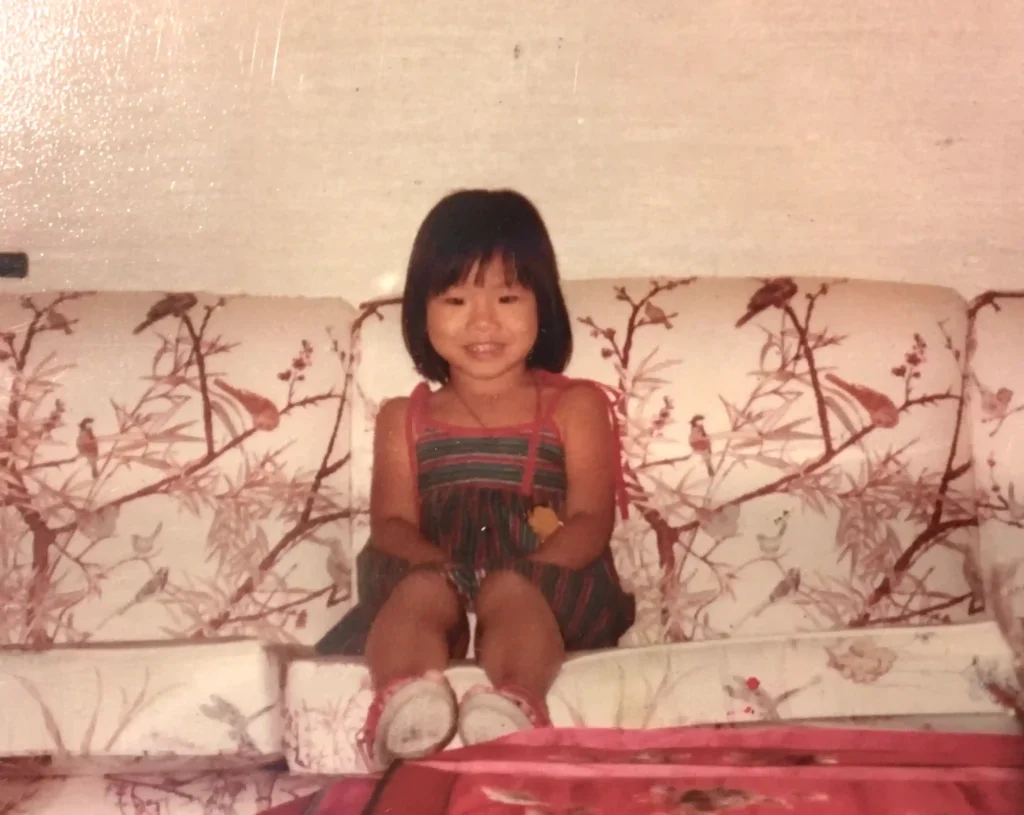
ORIGIN STORY – Before the Label
As a kid, I was the chatterbox, the daydreamer, the girl who always seemed somewhere else. I struggled in school, all the way through O Levels. I never took to academics, and my short-term memory was (and still is) rubbish. No matter how hard I tried, I just couldn’t focus long enough to prove anyone wrong.
I kept things lively wherever I went, always ready with a witty quip or a joke that brought a bit of lightness to any room. My Chinese teacher called me “白日梦” (bái rì mèng), the daydreamer, which really summed up my attitude toward schoolwork. I couldn’t focus in class, and when I sat down to do homework at home, I felt physically restless, like an itch under my skin I couldn’t shake. It was truly unbearable.
I scored 180 for my PSLE. Even now, after all my rationalising, that number still stings. I felt humiliated, and the shame was hard to bear, especially coming from one of those “elite” schools in Singapore. For a long time, I avoided telling people which primary school I attended (although, honestly, no one really asks once you’re an adult), because their gasps of shock were just too much. It was a harsh realisation about my academic ability and my worth. My bright future as a 12-year-old suddenly felt smited.
As I moved through adolescence, some subjects finally clicked, and I discovered I was good at a few things, though I still struggled with others. I didn’t get into Pre-University, Junior College, or Polytechnic. Instead, I landed at art college, which felt like a polite consolation prize. Maybe I could pass off as creative. I was, but not in the traditional sense – I could never sit still or colour inside the lines in formal art class, but I loved coming up with new ideas (did that count?). I used to joke about how dumb I was, as if that might soften the blow. For some of us, art college was simply where we ended up because there weren’t many other options.
Being the youngest and only girl with two older brothers who barely acknowledged me, I spent a lot of time in my own world. I played pretend, made up stories, and lost myself in fantasy and thought. In secondary school, I discovered napping as an escape. The places in my head always felt more interesting than real life.
People often called me creative or “the quirky one.” But my school results never matched my personality or the energy I brought into a room. In a system that measured everything by academic achievement, that disconnect was tough.
Where Did I Fit?
As a teen, I made friends easily, but sometimes lost them, often over something I did or said without thinking. I always felt like I was trying to impress people, desperate to be liked, but often coming across the wrong way. I wanted to find my version of “friends” like the ones I saw on TV or in movies, the cool group who just knew you. Of course, expectations never matched reality. Deep down, I knew I was different. There’s that saying, “everyone is special in their own way,” and I wanted to believe it, but honestly, I felt unremarkable, always almost a fit but not quite.
Things shifted in my 20s. The friendships I made then became deeper and lasted much longer. I started to find “my people,” those who valued my quirks and creativity, who didn’t just tolerate my humour but actually enjoyed it. Around that time, I realised I liked being different, because for the first time, I was genuinely appreciated for my uniqueness. Art college gave me a taste of what it meant to be celebrated for being different, but adulthood is where I truly found lasting, meaningful friendships.
Adulting is hard. There’s always comparison, but context is everything. Over time, I learnt there is value in being who I was, and the importance of self-authenticity. Why be like everyone else? I cared less about what everyone thought and started listening to the opinions of only a select few. That helped me stay truer to myself. I didn’t need to impress everyone anymore (or maybe that was just arrogance masking low self-esteem).
The failure of PSLE or O Levels taught me something no grade could. There are other yardsticks you can measure yourself against, not just one. This is different from being denied opportunity based on ability. It’s about finding freedom in being able to choose how you want to challenge yourself, and in what context. That’s real liberation.
Still, Singapore’s pressure to conform was always there, even after studying and living in Melbourne and Berlin. Freedom overseas felt exhilarating but also lonely. I thought living abroad would help me find a place where I fit, but I didn’t. One place I did find belonging after returning to Singapore was in Film and TV post-production. My quirks were an asset, I was good at my job, and as the only female in the room, I stood out (not always in the way I would have liked, but that’s a different story).
Dating was another challenge. It wasn’t always easy to find someone who could really see and accept me, quirks and all. I think I was “too different,” and most guys just didn’t know what to do with someone like me.
After a few heartbreaks, I learned how to be happy on my own terms, without needing someone else to secure that for me. My happiness wasn’t dependent on anyone else.
What Did I Internalise?
Money was always a shadow lurking in the background. I carried so much shame about my credit card debt. I thought it made me irresponsible, unreliable, unstable, not good “long-term partner” material. For years, I believed I couldn’t get adulting right and basically just wasn’t enough.
But in my 30s, things began to shift. I started to notice what I could do, not just where I fell short. I’d dive headfirst into new interests, sometimes getting really good at things, and was surprised to find I kept at these hobbies for years; they weren’t fleeting.
These mini-wins built my confidence. I enjoyed doing difficult things that I found challenging, things not everyone could do. I wasn’t earning big bucks in a corporate job, but my work was on TV and I even had an IMDB page. That was a big deal in the early 2000s.
My social circle changed too. There were lots of strong, independent women and friends in the LGBTQ+ community. For a while, I think people just assumed I was gay. Honestly, I didn’t mind; at least nobody expected me to be “normal.”
By my mid-30s, I realised that if I was going to be in a relationship (and eventually I was), I wanted someone who appreciated me as me. I was tired of conforming to any stereotype or “should.”
REVELATION – The Turning Point
My diagnosis came sideways in my 40s. My husband had been diagnosed with ADHD, and around the same time, I began to suspect my daughter might be ADHD too. I was reading up for a counselling paper and started seeing myself on every page. The hyperactive stereotype never fit me. My energy was more internal. But over the years, I’d noticed a shift. I found myself struggling with tech (something I used to geek out on), fatigued after outings, and just not as sharp as I used to be.
Motherhood, it turns out, was the catalyst. Life transitions mean shifts in identity, and I was lost. I wasn’t a sought-after designer anymore. I became someone’s wife and then someone’s mum. I was untethered and it was disorienting at times. I was “between things” for a long time.
Then, I stumbled onto Unlocking ADHD and saw a post about a NUH research study. I signed up, and suddenly the pieces started falling into place.
How Did It Feel?
Diagnosis brought relief and validation. It felt like liberation, a homecoming. Suddenly, there was a language for my experience. I felt myself returning to me. There was clarity. For the first time, I stopped asking the existentialist, “Who am I?”
Taking ADHD meds, I realised just how much “brain fog” had been my baseline. Everything felt lighter.
I could finally see my past, my family, and my relationships with more understanding and a lot more self-compassion.
Who Helped Me Reframe?
My research changed everything. Interviewing other neurodivergent therapists for my dissertation gave me language, context, and a sense of community. Their stories mirrored mine. The hundreds of academic papers and studies were illuminating, and helped me find my own voice again, and purpose. Knowledge is empowering.
Facebook groups, especially ones for therapists, and the Unlocking ADHD community were invaluable. Through it all, working with clients who shared similar struggles deepened my empathy for myself and for them.
My story is definitely still unfolding.
INTEGRATION – Owning My Narrative
Now, knowing I have ADHD shapes how I work as a therapist. My lived experience lets me show up for clients in a way that’s real and human. I am able to sit in the mess with them, help them spot strengths they might not see, and normalise what they’ve been told is “too much,” “all over the place,” or “speaking too fast.” Psychoeducation, gentle self-compassion, and just being open about the journey are the tools I bring. It’s about making sure others know they’re not alone.
I’m proud to say I’m creative, quirky, and yes, these days, I’ll even own that I’m smart. That’s something younger me would never have dared to say.
One full-circle moment came 2 years ago, when I was sitting in my old primary school hall, listening as the principal described the success of Tinker Thursdays, a recess programme I helped create and led as a Parent Volunteer. The parents in that hall would once have been my peers, the very ones I never felt I could match up to. To go from “lowest PSLE score” to someone who made a mark on the same school was deeply healing.
What Am I Still Unlearning?
Self-doubt doesn’t just disappear. There are still days when perfectionism creeps in, or when I wonder if I’m “enough.” I catch myself nagging my daughter about school, knowing all too well how the system grinds down kids who don’t fit the mould.
Unlearning old narratives takes time. The pressure to conform hasn’t vanished, but now I have words and a community to hold onto.
IMPACT – Why Share This Now?
I’m sharing this now because so many neurodivergent people often grow up feeling alienated, like you’re always on the outside, looking in.
With the overwhelming tide of social media content about what ADHD is or isn’t, it can feel even harder to believe you have permission to feel legitimate. That sense of difference can be heavy and isolating.
My birthday is around the corner, and I’m almost 50. Honestly, it’s taken me a very long time to feel seen and understood, to be comfortable in my own skin. Whether it’s because of my neurodivergence, my age, or both, I can’t say for sure.
What I do know is this: if even one person reading this feels less alone or more hopeful, I want you to know that you are enough. There’s something quietly magical about connecting with someone who just gets it, no explanations needed.
It’s a journey because the destination is always shifting. I am still evolving.
If I could bust one myth, it’s this: “Everyone’s a little bit neurodivergent.” Nope, we’re not all the same. Our struggles and resilience are real, and they deserve to be seen, not dismissed.
Final Word – You’re Not Alone
If you see a piece of yourself in my story, I hope you feel less alone. This path isn’t easy. There are unfinished projects and hard days. But there are also moments of pride, connection, and genuine joy.
Your story matters, exactly as you are.
Need a space where you’re understood?
You’re always welcome at Therapeutic Space, where we talk honestly about neurodivergence, identity, and self-discovery, without shame and without masks.